
AIn’t it interesting – Inventory isn’t just a number!
In my last post of this series, I touched upon how forecasting is just the starting point, and how the real impact comes from the decisions that follow. If you take that one step further, inventory is usually where those decisions show up. At a high level, inventory looks like a number
a) how much stock do we have
b) how many days of cover
c) what’s the working capital impact
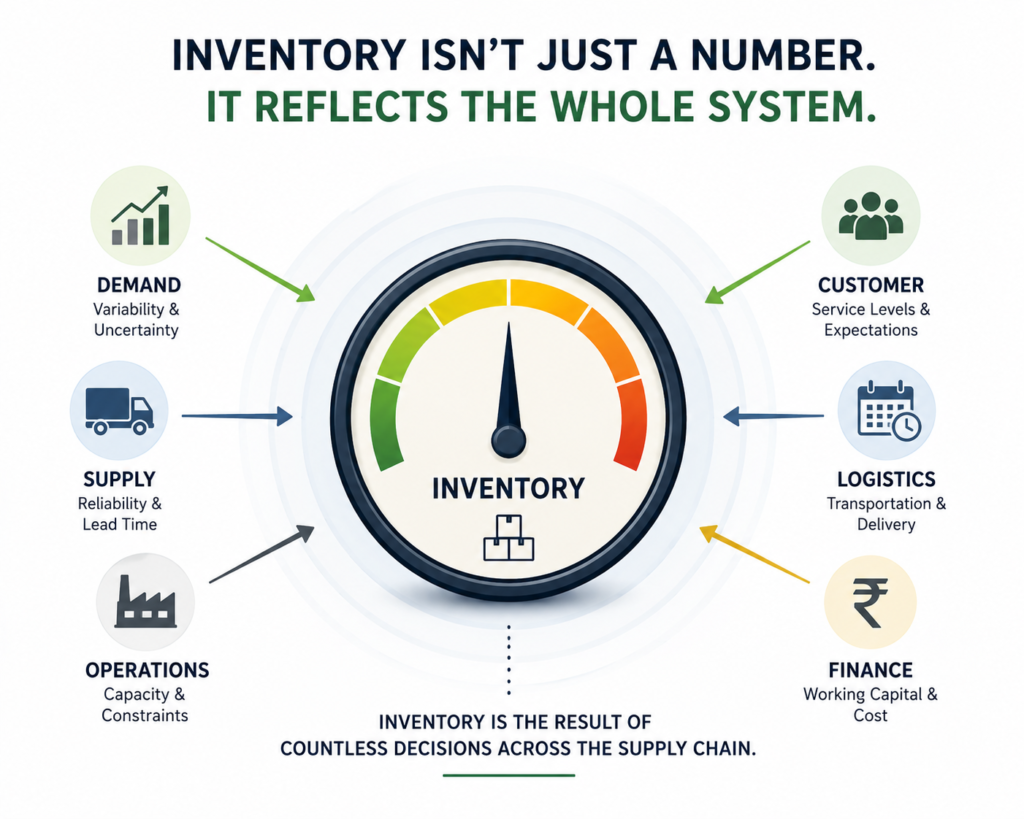
But in practice, inventory is where multiple tradeoffs converge
– service levels
– demand variability
– lead times
– supply reliability
– storage constraints
– WC pressure
Which means inventory decisions are rarely static, they are continuously adjusted based on signals coming from across the supply chain
It is probably worth nothing that many systems today treat inventory largely as a planning output
– forecast goes in
– policy gets applied
– inventory targets get generated
But in reality, inventory behaves more like a dynamic buffer
a) it absorbs variability
b) it reflects uncertainty
c) it compensates for delays elsewhere in the system
On the demand side (read enterprises), leaders seem to be looking at inventory differently, not just as something to optimize periodically, but something to actively manage as conditions evolve. They are trying to answer questions like
– where is inventory building up unexpectedly
– where are we at risk of stock-outs despite a stable plan
– which signals should trigger rebalancing decisions
This is also where AI seems to be finding a more natural fit
– help identify patterns across demand & supply variability
– surfacing early signals of imbalance
– recommending when and where to rebalance inventory before issues become visible
On the supply side, solution providers are also evolving in that direction
– multi-echelon inventory visibility
– dynamic safety stock adjustments
– exception based inventory management
– scenario simulation based on changing signals
And increasingly
– AI models that continuously learn from demand & supply patterns
– signal driven alerts that highlight emerging risks earlier
– recommendations on redistribution, substitution, or replenishment actions
– prioritization of decisions based on service and cost impact
It feels like a subtle but important shift – from inventory as a static outcome of planning, to inventory as a real-time reflection of how the system is responding to uncertainty
Because in many supply chains, inventory is a signal in itself. And AI, in many ways, seems to be less about optimizing inventory, and more about helping interpret what that number is trying to tell us, continuously.
AIn’t it interesting how inventory often tells you more about what’s going wrong in the system, than what’s going right?