AIn’t it interesting – Forecast isn’ the decision
In my last couple of posts, I have been unpacking how supply chains operate as System of Signals, and how much effort goes into interpreting those signals before acting on them.
If you follow that thread into a specific use case, Demand Forecasting is usually where the conversation starts
a) Forecast accuracy has been a long-standing focus in supply chains.
b) Better forecasts are expected to drive better planning, better inventory, and better service levels
c) With AI, forecasting capabilities have clearly improved, due to large volumes of diverse data, better models and more frequent updates
But in many discussions, an interesting aspect comes up.
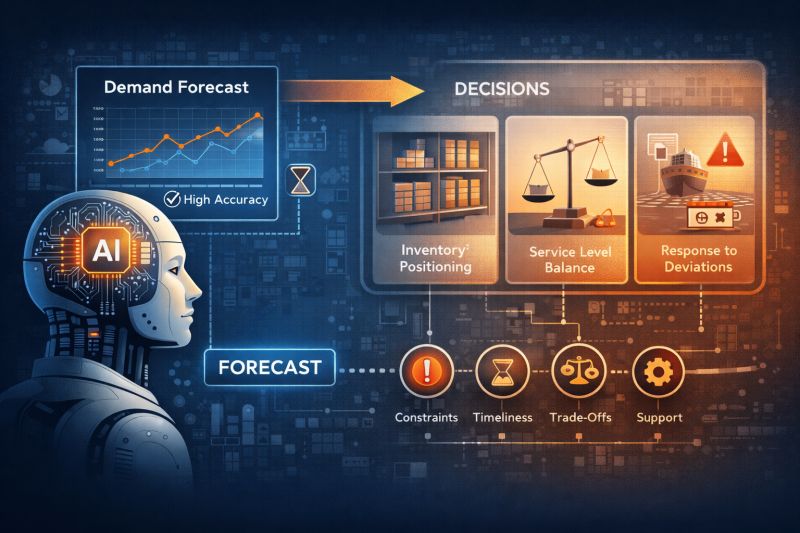
A better forecast doesn’t automatically translate into a better decision, because between the forecast and the outcome, there are several layers
a) how much inventory to hold? where to position it?
b) what service levels to target?
c) how to balance cost vs availability?
d) how to respond when reality deviates from the forecast?
In other words, the forecast is an input, NOT the decision itself, in many supply chains, planners don’t act purely based on the forecast, they also act on exceptions, constraints, and trade-offs.
A highly accurate forecast may still lead to suboptimal outcomes if
a) inventory policies are misaligned
b) constraints aren’t visible
c) signals aren’t acted on in time
d) decisions are delayed
On the demand side (read enterprises), this theme seem to be driving a subtle shift, leaders are still interested in forecast accuracy, but increasingly in how forecasts translate into actionable decisions.
On the supply side, one can see solutions evolving beyond forecasting
a) inventory optimization linked to demand signals
b) scenario planning and trade-off simulation
c) exception-driven planning workflows
d) decision support embedded within planning systems
It feels like the conversations are moving from ‘how accurate is the forecast?’ to ‘what decisions does the forecast enable?’, because in practice, supply chain outcomes are shaped less by the forecast itself, and more by how quickly and effectively decisions are made around it
AIn’t it interesting how one of the most discussed AI use cases in Supply Chains (i.e., forecasting), may not be the real lever, but just the starting point for better decisions?