AIn’t it interesting – Signals are already there !!
In my last few posts of this series, I have been exploring how supply chains operate as System of Signals, and how significant effort goes into interpreting those signals across demand, supply, inventory & execution.
One question that often comes up in conversations is – Do we need NEW data to make AI work in supply chains?.
The good news is, in many cases, signals already exist
– demand signals are in OMS & CRM
– supply signals sit in procurement and supplier collaboration tools
– manufacturing signals are captured in MES and production systems
– inventory signals live in WMS and ERP
– logistics signals flow through TMS and tracking platforms
The challenge is rarely about lack of data, it is fragmentation!
– each system captures a part of the story
– each signal exists in isolation
– and most decisions require connecting signals across these systems
So, supply chain teams end up stitching things together manually
– exporting reports & reconciling numbers
– following up over e-mails and calls
– trying to build a coherent picture from disconnected signals
On the demand side (read enterprises), there seem to be a growing interest in seeing signals together. Not just demand vs supply, but how demand changes are impacting inventory, production, and logistics, in near real time
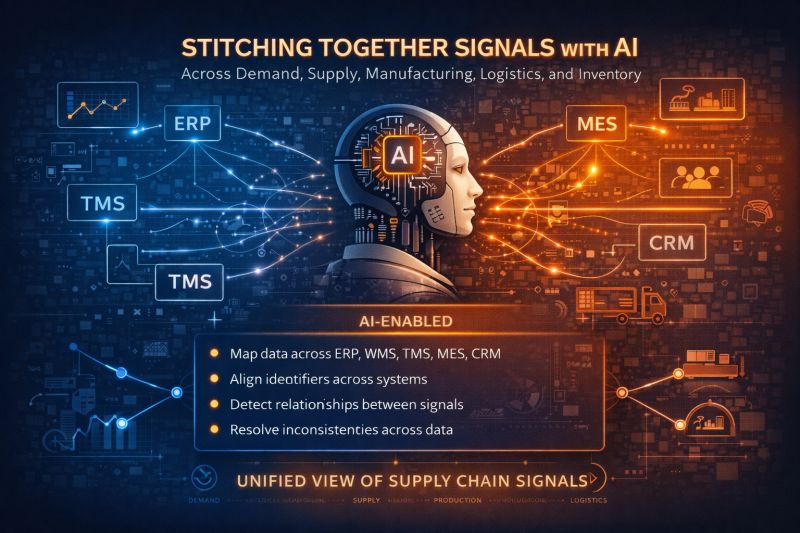
This is where AI seem to be finding a practical role, by stitching and interpreting existing signals across systems
– mapping related data across ERP, WMS, TMS, MES, & CRM
– aligning different identifiers (SKUs, locations, suppliers etc) across systems
– detecting relationships between seemingly unrelated signals
– reconciling inconsistencies across datasets
On the supply side, one can see solution providers moving in that direction
– ingesting data from multiple enterprise systems
– building a unified signal layer across demand, supply, and execution
– correlating events across systems
– surfacing cross-functional exceptions that require coordinated action
And increasingly using AI to
– identify patterns across fragmented data that is hard to detect manually
– prioritizing signal based on potential business impact
– enabling faster & synchronized decision-making across teams
It feels like another subtle shift, from System of Record operating in silos
to System of Signals, that are continuously connected and interpreted, in most supply chains, the information isn’t missing, it’s just not seen together.
And AI, in many ways, seem to be less about generating intelligence, and more about connecting the dots that already exist across systems.
AIn’t it interesting how the real challenge may not be about MORE data but making existing signals visible, connected and actionable?